

A balcony in Vancouver lives a hard life. Months of rain, winter freeze-thaw cycles, and constant moisture will destroy a poorly built tile installation within a few seasons — cracked grout, loose tiles, water leaking into the unit below. But done right, a tiled balcony can look stunning and last for decades. Here’s what actually works in our climate.
Why Balcony Tiles Fail in Vancouver
The #1 killer is trapped water. Traditional installations glue tile directly to the concrete slab with grouted joints. Water seeps through the grout, gets trapped underneath, and when temperatures drop, it freezes and expands — popping tiles loose and cracking grout. In a city where it rains through much of the year, that’s not a question of if, but when.
The Method That Solves It: Pedestal and Track Systems
The modern approach — the one we now recommend to every client — doesn’t glue tiles to the slab at all. Instead:
- The concrete slab is fully waterproofed first. This is the primary weather barrier.
- Aluminum tracks and adjustable pedestals are anchored to the waterproofed slab, raising the tile surface above it.
- Thick porcelain pavers (typically 2 cm / 3/4 inch) rest on the pedestals — they’re not glued down.
- The joints between pavers are left open with no grout, held evenly spaced by stainless steel spacers.
Rainwater flows straight through the open joints and drains away beneath the pavers. Water never pools on the surface and never gets trapped — so there’s nothing to freeze, expand, and crack in winter.
Why This System Is Ideal for the Lower Mainland
- Drainage, not resistance. Instead of fighting water with sealers and grout, the system lets water pass through harmlessly.
- Freeze-thaw proof. No trapped water means no freeze damage — critical for Vancouver winters.
- Rust-proof components. Stainless steel spacers and aluminum tracks won’t corrode in constant moisture.
- Slip-resistant surfaces. Quality porcelain pavers have textured, non-slip finishes that stay safe underfoot when wet.
- Easy repairs. Because pavers aren’t glued down, a single damaged paver can be lifted and replaced without tearing up the whole balcony.
- Stunning look. Large-format 24×48 inch pavers give balconies a clean, high-end finish.
A Real Example: Concord Metrotown, Burnaby
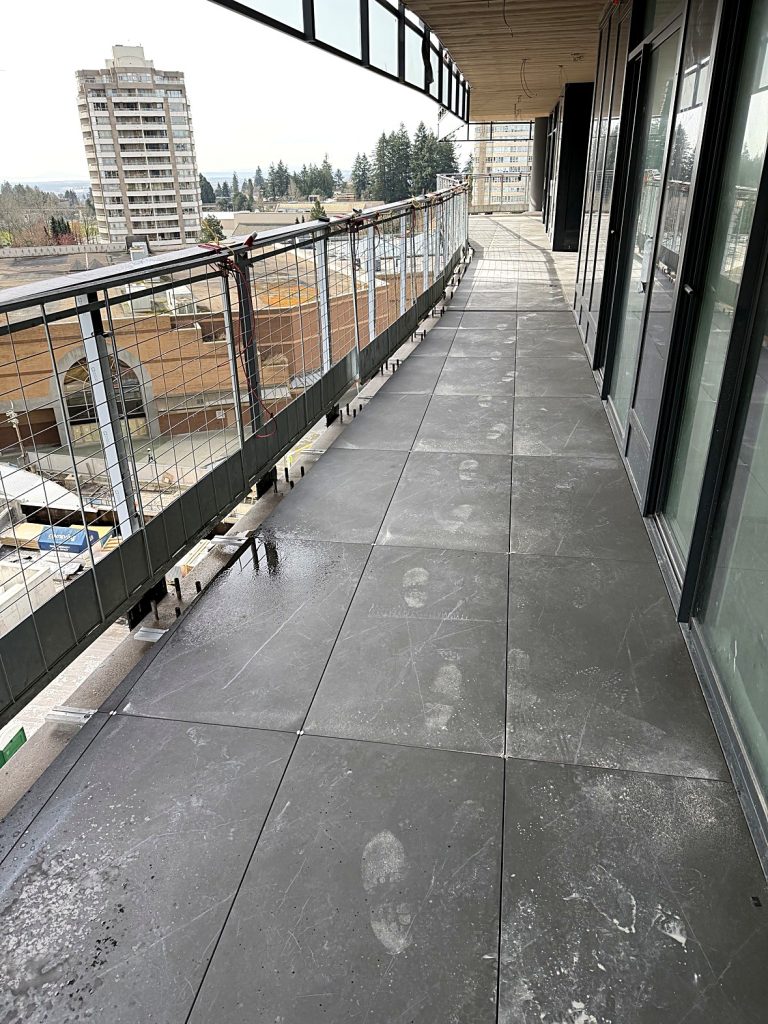
We recently completed balcony tiling at Concord Metrotown in Burnaby using exactly this method — waterproofed substrate, aluminum track and pedestal system, 60×120 cm porcelain pavers with open joints and stainless steel spacers. The result is beautiful, and more importantly, it’s engineered for decades of Vancouver rain. See the full project with photos.
What to Ask Any Balcony Tiling Contractor
- How is water handled? (If the answer is “grout and sealer,” keep looking.)
- Is the substrate waterproofed independently of the tile?
- Are the pavers glued down or on a pedestal system?
- What keeps the joints even — and are the spacers rust-proof?
- What happens if one paver cracks — can it be replaced individually?
Frequently Asked Questions
How much does balcony tiling cost in Vancouver?
It depends on balcony size, paver choice, and the condition of the existing slab. Contact us for a free on-site estimate.
Can you tile over my existing balcony surface?
Sometimes — it depends on the condition and slope of the existing slab. We assess this during the free consultation.
How long does a balcony tiling project take?
Most residential balconies take 2–4 days depending on size and prep work needed.
Get a Balcony Built for Vancouver Weather
If your balcony tiles are cracking, or you’re building new and want it done right the first time, get a free estimate or call (778) 855-6606. We serve Burnaby, Vancouver, Surrey, and surrounding cities.